The Story
How to Inspect a Wholesale Jewellery Delivery and Report Defects
A wholesale delivery should be checked before its contents are mixed with existing stock or placed on sale.
The order may contain the correct number of packages but still include a wrong finish, an incomplete set or a piece that needs further inspection.
A wholesale jewellery delivery inspection connects what arrived with what was agreed. This guide explains how to organise that review and prepare a useful report when something differs.
Prepare the Order Records Before Opening
Keep the final order confirmation, invoice, packing list and approved specifications available.
Identify the latest sample or finish reference. If changes were approved after the original quotation, include those records too.
Before ordering, agree with the supplier:
When issues should be reported.
Which contact should receive the report.
What photographs or other evidence are required.
Whether particular unboxing records are requested.
How proposed returns or repairs will be authorised.
Do not assume every supplier uses the same reporting window or resolution policy.
Record the Parcel Condition
Check the package identification and visible condition before removing the contents.
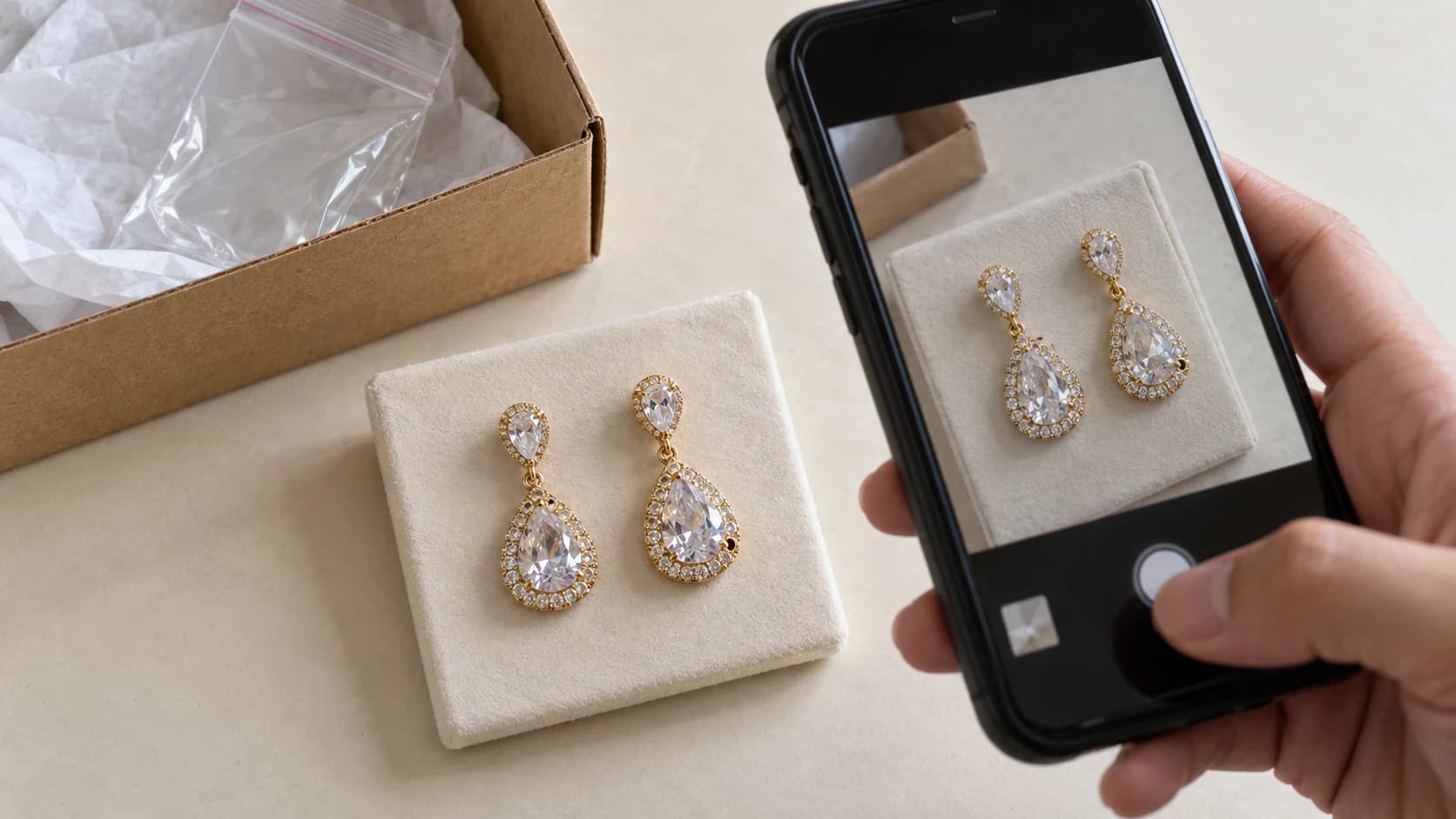
Photograph damaged areas, disturbed seals or other concerns alongside the parcel reference. Preserve relevant packaging while the issue is reviewed.
If the agreed process calls for an unboxing video, prepare the camera before opening and keep product identifiers readable.
A recording can document the opening process. It does not independently establish when or why damage occurred.
Avoid discarding labels that connect the parcel to the shipment.
Reconcile Quantities and Set Contents
Count the received units against the order and packing list.
Use the correct unit: one piece, one pair or one complete set.
For necklace sets, confirm the necklace, both earrings and any other included components. Check separately packed accessories before recording a shortage.
Create a receiving record:
SKU and variantOrderedReceivedCheckedDifferenceDesign A, approved finish4 sets4 sets4 setsNone recordedDesign B, green accents3 pairs2 pairs2 pairsOne pair not located
These figures are illustrative.
Keep shortages, wrong variants and workmanship concerns as separate findings. They require different follow-up questions.
Compare Jewellery with the Agreed Reference
Use the final written specification and approved sample where available.
Review the design version, dimensions, finish, stone arrangement and set contents. Assess intentional asymmetry or antique detailing against the reference rather than treating every difference as a defect.
For finish comparisons, use consistent lighting. A new piece and a worn display sample may look different for reasons that need investigation.
Our jewellery sample approval checklist explains what an approval record should contain.
Check Product-Specific Workmanship
Inspect the front, back and sides through normal handling.
For necklaces, review link movement, pendant orientation, contact edges and closure operation. For earrings, compare the pair and inspect posts, hooks and fastenings.
For rings and bangles, confirm the ordered size and relevant dimensions.
Record visible concerns such as missing stones, broken connections, rough projections or a closure that does not operate normally.
Use the relevant category guide for more detail:
Do not bend fittings, tighten settings or attempt repairs before documenting the condition and discussing the next step.
Distinguish an Observation from Its Suspected Cause
Describe what you can demonstrate.
For example:
Observation: “The clasp does not close during normal operation.”
Unconfirmed explanation: “The parcel was crushed and damaged the clasp.”
The first statement records a finding. The second needs supporting evidence.
Similarly, an apparently dark stone might involve lighting, surface residue, backing or another issue. Photograph it and request assessment rather than immediately declaring a material fault.
Visual inspection does not verify silver purity or gemstone identity. Where those are in question, refer to the agreed specifications and suitable testing evidence.
State How Much Stock Was Inspected
Record the quantity received, quantity checked and number of affected units.
If you inspect five pieces from a larger shipment, describe the result as findings from those five pieces. Do not report the uninspected remainder as proven acceptable.
For larger orders, agree an inspection scope or sampling plan with the supplier and a suitable quality professional where needed.
Do not invent a universal defect allowance. Acceptance criteria should reflect the product and the agreed order requirements.
Keep Questioned Pieces Identifiable
Place items awaiting review apart from saleable stock, with the SKU and issue reference attached.
If several pieces share one design, give each affected unit a temporary identifier, such as A-01 or A-02.
Keep complete sets together, or record where their components are stored. This helps avoid returning the wrong earrings or losing the connection between photographs and the physical piece.
Preserve the condition while the supplier reviews the report.
Photograph Each Issue Clearly
Use one image showing the complete item and another showing the specific concern.
Include a readable product reference. Where a measurement matters, show the relevant measurement clearly and state the method used.
Label image files consistently, for example:
Order123_DesignA_Unit02_Clasp.jpg
Avoid filters or editing that changes the apparent finish. If you add an arrow to highlight the location, retain the original image too.
Check that the evidence demonstrates the issue before sending a large collection of unrelated photographs.
Prepare a Jewellery Defect Report
Report fieldWhat to includeOrderInvoice or purchase-order referenceDeliveryDate received and parcel referenceProductSKU, finish, size and set contentsInspection scopeQuantity received and checkedFindingSpecific observed differenceAffected quantityCount by issue typeReferenceAgreed specification or approved sampleEvidencePhotograph and video filenamesRequested next stepAssessment, clarification or proposed remedyStatusAwaiting review, agreed action or resolved
Avoid counting the same unit twice when it has more than one issue. Record both the number of affected units and the individual findings.
Agree the Resolution Before Taking Action
Ask the supplier to acknowledge the report and confirm the proposed next step.
Possible arrangements may involve further inspection, repair, replacement, return or an agreed adjustment. Availability depends on the terms and the findings; none should be assumed automatically.
Confirm responsibilities, transport arrangements and any charges before sending items back.
Keep the written agreement with the order records. When corrected or replacement pieces arrive, check them against the agreed action before closing the issue.
Use the Findings to Improve Future Orders
Recurring problems can indicate a specification or packing requirement that needs clarification.
For example, repeated tangling may justify reviewing how hanging components are supported. Repeated variant mix-ups may call for clearer labels.
Our guide to wholesale jewellery packaging specifications explains what to agree before dispatch.
Update the relevant order instructions and references rather than relying on the same verbal reminder for every purchase.
Discuss Wholesale Jewellery Requirements with Varnya Jewels
Varnya Jewels works with retailers, wholesalers and jewellery brands sourcing silver jewellery from Jaipur.
Before confirming an order, discuss product specifications, inspection priorities, packing and the process for reporting questions after delivery.
Discuss a wholesale jewellery order or request our wholesale catalogue.
End of story
Thank you for reading.