The Story
Moissanite Necklace Quality Checklist for Wholesale Buyers
A necklace can look balanced in a catalogue photograph yet twist, sit unevenly or feel awkward when handled.
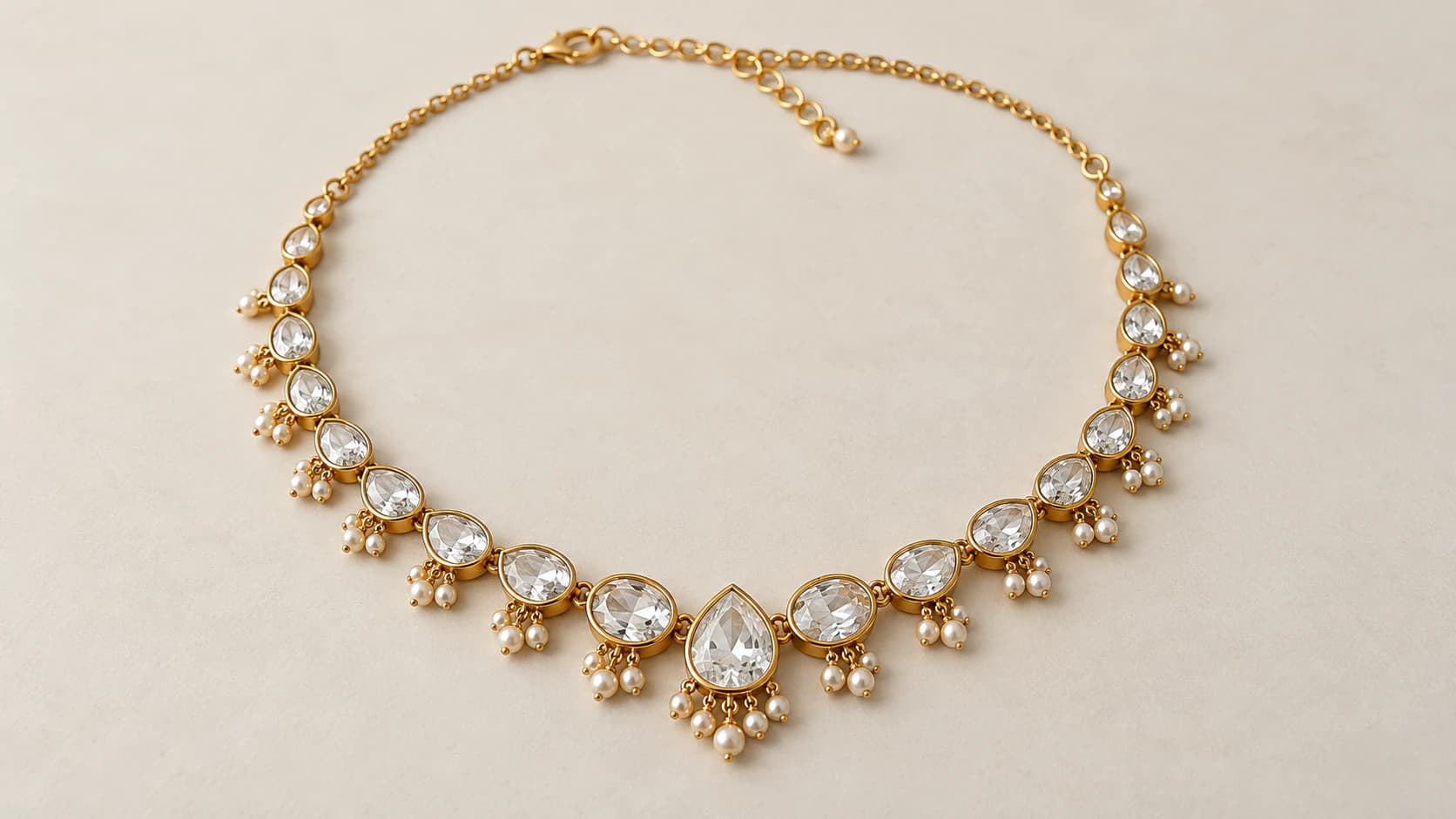
For retailers and wholesalers, selecting Moissanite necklace sets requires attention to the complete construction: stone settings, connected sections, pendant movement, closures and matching earrings.
This Moissanite necklace quality checklist provides a practical way to review those details before placing a wholesale order.
Confirm the Design and Complete Set
Start by identifying the exact product being reviewed.
Record the SKU, finish, stone colours and set contents. Confirm whether the quoted selection includes the necklace alone or matching earrings and other accessories.
Ask whether the piece shown is ready stock, a development sample or a reference for production.
When shortlisting wholesale Moissanite necklaces, request the specifications for individual designs. A collection name does not identify every material or component.
Check How the Necklace Sits
View the necklace laid flat, on a suitable display stand and, where practical, worn.
Each view answers a different question. A flat view helps assess layout, while a worn view helps reveal how the necklace follows the neckline.
Look for:
A centrepiece that sits in the intended position.
Side sections that follow the neckline without awkward gaps.
Drops that face forward rather than turning.
Links that move without overlapping unintentionally.
A fastening position that supports the intended fit.
An asymmetrical design should be assessed against its approved layout. Do not treat intentional differences as defects.
Review Articulation Between Sections
Many statement necklaces use connected motifs or panels. Their movement affects how the piece settles when worn.
Gently lift and reposition the necklace through normal handling. Check whether connected sections articulate smoothly and return to their intended arrangement.
Ask the manufacturer to review:
Sections that repeatedly lock together.
Links that catch against adjacent settings.
Panels that rotate unexpectedly.
Drops that become trapped behind the necklace.
Areas where movement exposes unfinished connections.
Do not force the necklace flat or bend links to test them. If a connection needs adjustment, identify the location and request inspection.
Examine Stone Settings from Several Angles
Inspect the front, sides and back under steady lighting.
Look for visibly tilted stones, unintended gaps, inconsistent alignment, missing components or rough setting edges. Compare similar stones across the design.
The appropriate setting depends on the stone shape and construction. A prong-set necklace and a Polki-inspired design should not be judged against an identical setting checklist.
Record concerns with close-up photographs. Ask a qualified jeweller or the manufacturer to assess setting security where necessary; appearance alone cannot establish it.
GIA’s workmanship resources demonstrate the value of evaluating settings, finishing and assembly systematically, although its individual benchmarks apply to specific constructions. Explore GIA’s Quality Assurance Benchmarks.
Inspect the Pendant and Hanging Drops
A necklace’s centrepiece may be heavier or deeper than its side sections.
Check whether its attachment allows it to face correctly without excessive tipping or unwanted rotation. Review how hanging drops behave when the necklace moves.
Confirm that:
Suspension points match the intended design.
Drops have sufficient clearance to move.
Decorative components do not repeatedly strike or trap one another.
Left and right elements match where symmetry is intended.
The pendant sits at the agreed height.
If the necklace uses beading or a thread-based adjustment, ask how these components support the intended fit and how replacements or repairs would be handled.
Operate Closures and Adjustment Mechanisms
Open and close the fastening using normal handling.
Review the clasp, adjustment chain, hooks, thread mechanism or other closure supplied with the design.
Check that:
The closure can be operated without excessive difficulty.
Adjustment points are accessible.
Connections appear closed and properly finished.
Sharp ends do not press against the wearer.
The available adjustment range matches the specification.
A smooth demonstration does not establish long-term strength. Agree separately on any functional testing or inspection required for the order.
Check the Back and Contact Surfaces
The back of the necklace is important for comfort and handling.
Inspect surfaces that may touch skin or clothing, including setting backs, joints, link ends and fastening components.
Look for rough areas, sharp projections, visible residue and unfinished surfaces. Check whether the reverse finish matches the agreed specification.
Do not try to remove residue with chemicals or polish the sample before reporting it. Altering the surface may make the original issue harder to assess.
Compare Matching Earrings as Part of the Set
Review both earrings beside the necklace rather than approving them separately from memory.
Compare:
Overall dimensions and intended symmetry.
Stone arrangement and colours.
Finish tone.
Drop lengths and movement.
Posts, hooks and fastening position.
Weight per earring or pair, as specified.
Where hygienically appropriate, assess how the earrings hang when worn. A balanced photograph does not show whether the fastening position makes an earring lean forward.
Record Finish, Dimensions and Weight Clearly
Measure the necklace length, adjustment range and important pendant dimensions. Record the earring measurements separately.
For finish approval, compare the complete set under consistent lighting. Our guide to Victorian polish vs gold polish on silver jewellery explains how to document colour and darkened detailing.
Ask what each weight figure includes.
In Varnya’s quotation terminology, set Polki and stones are included in the quoted net weight, while beading weight is recorded separately. This quoted net figure is not the silver-alloy-only weight and should not be used to calculate pure silver content.
Keep the billing definition separate from your assessment of fit and comfort.
Use a Necklace Inspection Record
AreaWhat to recordProduct identitySKU, finish, variant and set contentsFitPosition on the neckline and centrepiece orientationArticulationMovement of panels, links and dropsSettingsLocation and photographs of visible concernsClosureOperation, adjustment range and contact pointsReverseFinish, edges and connectionsEarringsPair consistency and match with the necklaceMeasurementsActual dimensions and defined weight figuresDecisionAccepted details, required changes and next review
Use specific observations. “Pendant turns sideways during normal movement” is more useful than “quality needs improvement.”
Agree What Happens Before Dispatch
Once the sample meets the agreed requirements, retain an identified reference and written specification.
Confirm how the supplier will inspect the order, what information will accompany dispatch and how differences should be reported.
An approved sample is a comparison reference; it does not establish that every production piece has been individually checked.
Use our jewellery sample approval checklist to document the approval decision and any unresolved changes.
Review Moissanite Necklace Sets with Varnya Jewels
Varnya Jewels works with retailers, wholesalers and jewellery brands sourcing silver jewellery from Jaipur.
Share the necklace references, quantities, finishes and set requirements you want to review. Ask for close-up views, dimensions and available specifications for the selected designs.
Request a Moissanite necklace catalogue or video call to discuss your wholesale selection.
End of story
Thank you for reading.