The Story
Jewellery Sample Approval Checklist Before Bulk Production
A jewellery sample may look attractive at first glance while still needing changes to its dimensions, fastening, finish or construction.
For retailers, wholesalers and jewellery brands, sample approval is the point at which the intended product becomes a documented reference for production. A message saying “looks good” can leave important questions unresolved.
This jewellery sample approval checklist explains what to inspect, what to record and how to communicate your decision before a bulk order proceeds.
Start with the Correct Sample and Design Version
Before inspecting the piece, confirm what the sample is intended to demonstrate.
Is it a complete finished sample, a construction prototype or a colour reference? A prototype made to assess proportions may not use the final stones or finish.
Record:
Project name and SKU.
Sample reference and revision.
Date received.
Relevant drawing or CAD version.
Whether materials and finish match the proposed production specification.
Any temporary components or known limitations.
Compare the sample with the latest agreed requirements. If those requirements are incomplete, use our custom jewellery design brief to organise them before approving production.
Inspect the Sample in a Consistent Way
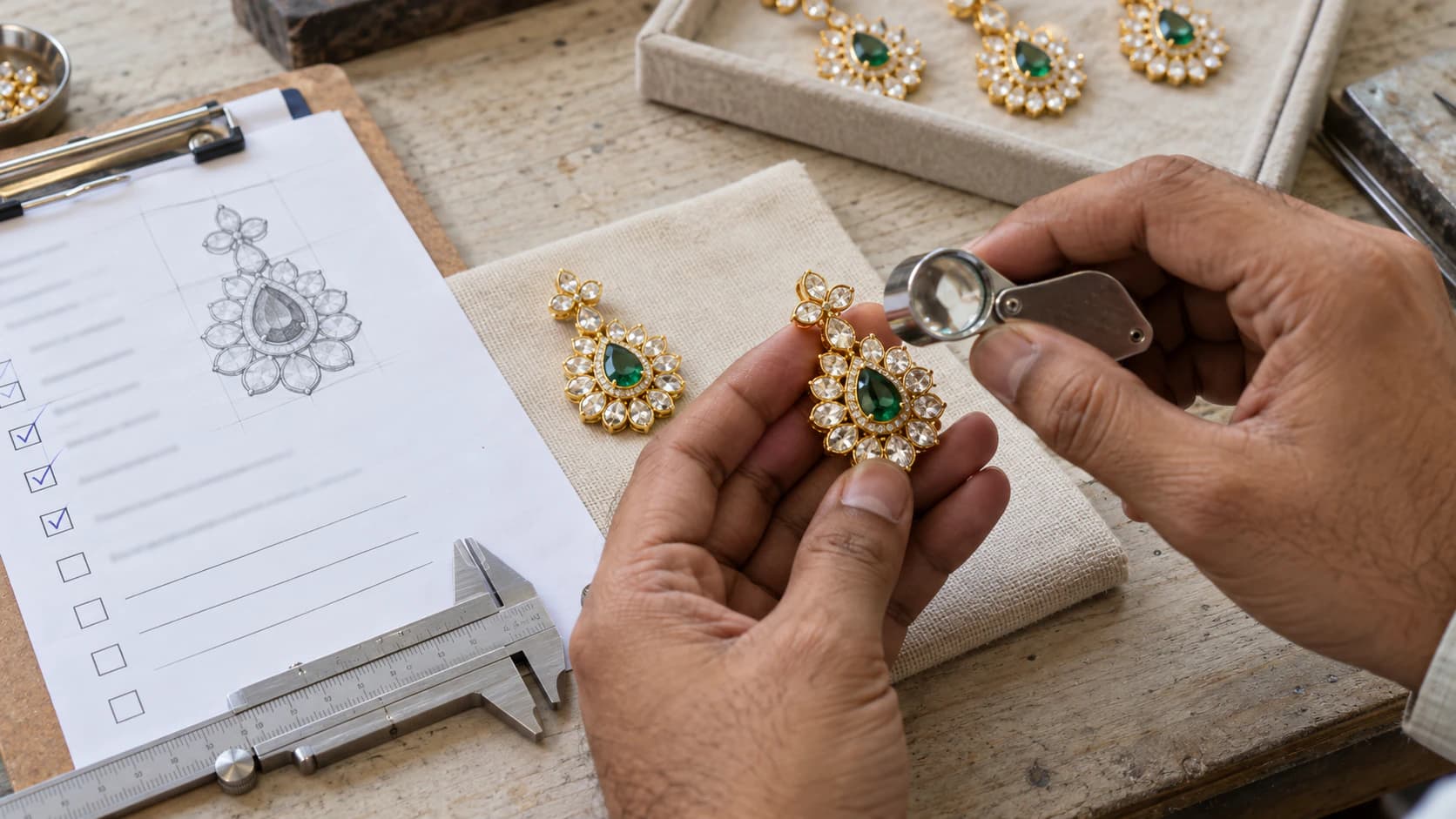
Use a clean, well-lit surface, suitable measuring tools and the written specification. Photograph observations so the manufacturer can identify the exact area you mean.
Handle the sample normally. Do not bend settings, pull components forcefully or perform chemical tests unless a suitable testing procedure has been agreed.
1. Confirm Materials and Set Contents
Check that the supplied information identifies the base metal, purity, main stones and additional components.
For a necklace set, confirm whether the approved contents include matching earrings or other pieces.
Visual inspection alone does not establish silver purity, gemstone identity or coating thickness. Where verification is required, agree on appropriate testing and what the resulting evidence covers.
For a 925 silver Moissanite jewellery order, the sample record should distinguish Moissanite from any coloured stones, beads or pearl-like components.
2. Measure Dimensions and Record Weight
Compare the sample with the agreed measurements.
Depending on the product, check:
Necklace length and adjustment range.
Pendant height and width.
Earring length and width.
Ring size or bangle dimensions.
Positions of important motifs and drops.
Record weight using the agreed basis. A gross finished weight should not be presented as net silver weight.
Agree acceptable variation for each important measurement with the manufacturer. Avoid applying an arbitrary percentage to every feature: a small difference in a ring size can matter differently from a small difference in a decorative drop.
3. Review Stone Settings and Visible Workmanship
Inspect the front, back and sides of the piece.
Look for visibly tilted stones, uneven spacing, missing components, rough setting edges or residue around the stones.
Where the design contains articulated sections, check whether the links move as intended without obvious obstruction.
If something appears loose or uncertain, mark the location and ask the manufacturer to inspect it. Avoid trying to repair or tighten the sample yourself before the issue is reviewed.
4. Operate Closures and Inspect Connections
Open and close clasps, earring fastenings and adjustment mechanisms using normal handling.
Check for:
Closures that are difficult to operate.
Misaligned posts or fittings.
Links with visible gaps.
Sharp or unfinished edges.
Connections that prevent the piece from moving correctly.
A simple handling check is useful, but it is not a substitute for any agreed strength or durability testing.
5. Compare Finish and Colour
Review the finish under consistent lighting and compare it with the approved reference.
Inspect exposed surfaces, recesses, backs, links and closures. Compare earrings side by side and assess the complete set together.
For Victorian finishes, intentional darkened detailing should be distinguished from unwanted patches or inconsistent coverage. For gold polish, confirm the agreed tone and brightness.
Our guide to Victorian polish vs gold polish on silver jewellery explains how to document those choices.
6. Assess Fit, Movement and Wearability
Where practical and hygienically appropriate, assess how the jewellery sits when worn.
A necklace may lie differently on a person than on a display stand. Earrings may appear balanced in a photograph but need adjustment to their weight distribution or fastening position.
Check whether:
The necklace sits in the intended position.
Pendants and drops face correctly.
Earrings hang consistently.
Moving sections catch on one another.
Edges or fittings create discomfort.
Record the intended fit and any concerns. One person’s assessment does not establish suitability for every wearer or body size.
Use a Sample Inspection Record
Keep observations specific enough for the manufacturer to act on.
Inspection areaRecordExample of actionable feedbackMaterialsConfirmed specification and supporting evidence“Please identify the green accent component in the specification.”DimensionsAgreed target and actual measurement“Pendant measures 46mm; approved drawing specifies 42mm. Please review.”SettingsLocation and photograph of concern“Stone beside the centre motif appears tilted; see photo 03.”ClosuresOperation and alignment“Clasp is difficult to open during normal handling.”FinishReference and observed difference“Back surface is brighter than approved finish reference F02.”WearabilityHow the issue occurs“Centre pendant turns sideways when the necklace moves.”
These examples illustrate reporting methods rather than universal acceptance limits.
Give a Clear Approval Decision
Use a status that makes the next step explicit.
DecisionMeaningApproved for productionThe identified sample and written specifications are accepted for the stated order.Revision requiredListed changes must be reviewed before production approval.Approved for a limited purposeOnly a specified feature, such as colour or dimensions, is approved. Bulk production is not authorised.
If a sample needs changes, state whether you require a revised physical sample, updated measurements or another form of evidence.
Avoid assuming that “approved with comments” has the same meaning to both parties. List what remains unresolved and whether production may begin.
Keep an Approved Reference for Production
Once approved, identify the reference sample and keep its photographs, measurements and specification together.
Agree who retains the physical sample. If the buyer and manufacturer keep separate references, confirm that both represent the same approved version.
Record the approval date and any agreed exceptions. Changes to stones, dimensions, components or finish should be reviewed against the approved specification rather than treated as automatic substitutions.
An approved sample provides a reference; it does not prove that every production piece will match. Agree how the finished order will be inspected before dispatch and checked on receipt.
Confirm Commercial Changes Before Authorising Production
Sample revisions can affect material requirements, price, quantities or scheduling.
Before approving the order, confirm:
Whether the quotation has changed.
The final quantity and design variants.
Applicable minimum order requirements.
Payment and production-start conditions.
Agreed inspection and defect-reporting arrangements.
Packaging and delivery requirements.
Refer to our guide on comparing wholesale silver jewellery quotations if the revised specification changes the quoted scope.
A Simple Written Approval Format
Use the following fields to make your decision traceable:
Project / SKU:
Sample reference and revision:
Drawing or specification version:
Materials and finish reference:
Approved quantities and variants:
Inspection findings:
Required changes or exceptions:
Approval status:
Is bulk production authorised? Yes / No:
Approver’s name and date:
Manufacturer acknowledgement:
Attach the relevant photographs and measurement record. If a change is made after approval, issue an updated record so both sides know which version applies.
Discuss Sampling with Varnya Jewels
Varnya Jewels works with jewellery retailers, wholesalers and brands on silver jewellery sourcing and custom development from Jaipur.
Share your design references, materials, quantities and inspection priorities to discuss the sampling requirements for your project. Confirm sample scope, charges and approval stages before development begins.
Discuss jewellery sampling and custom manufacturing with Varnya Jewels.
End of story
Thank you for reading.