The Story
CZ Jewellery Quality Checklist for Wholesale Buyers
Bright stones can attract attention, but sparkle alone does not establish the quality of a finished jewellery piece.
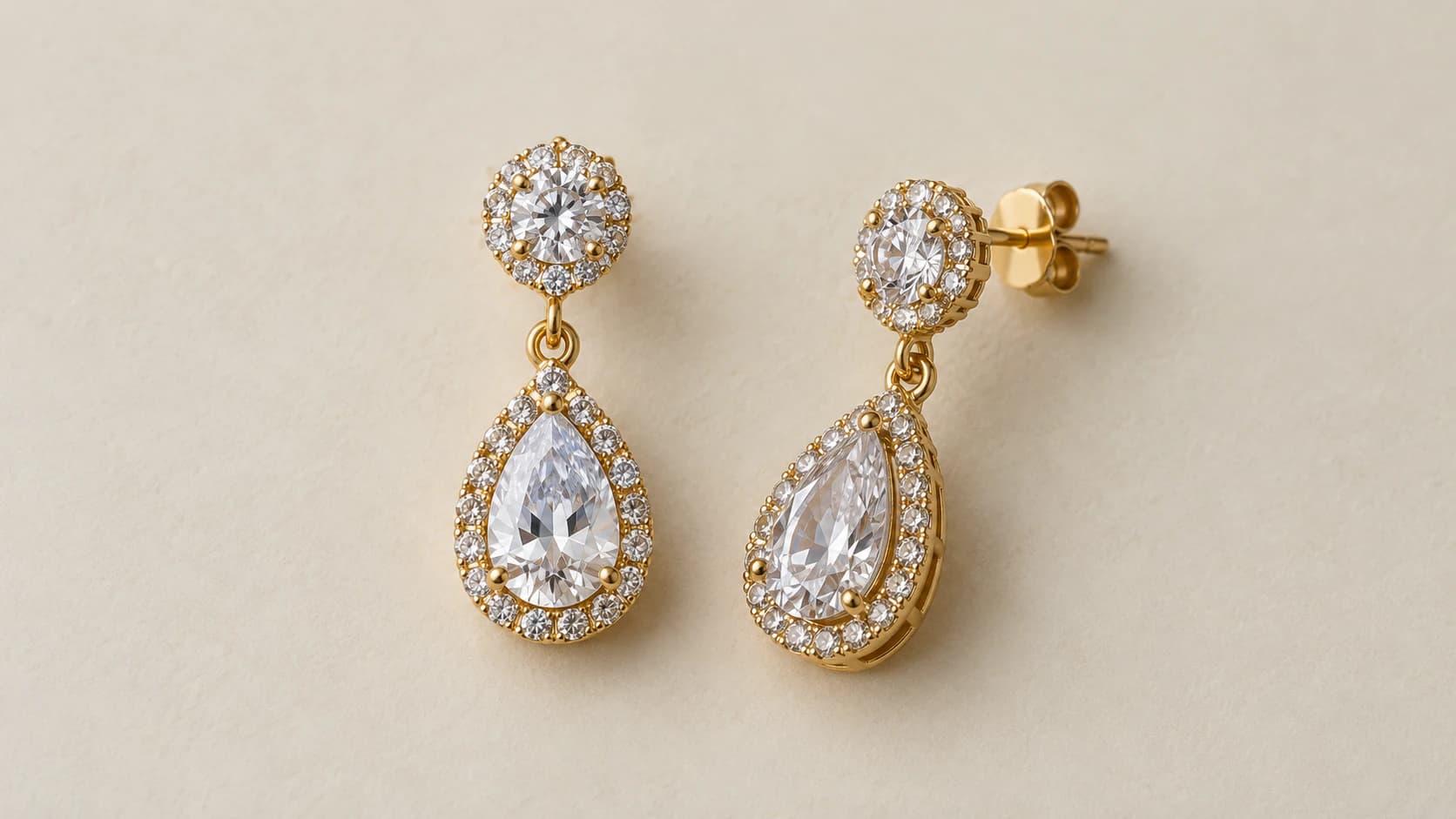
For retailers and wholesalers, evaluating CZ jewellery means reviewing the stones alongside their settings, metal, finish and construction. A necklace may photograph well while having uneven stone alignment, rough contact surfaces or poorly matched earrings.
This CZ jewellery quality checklist helps buyers assess samples and record clear requirements before placing a wholesale order.
Confirm What the CZ Description Covers
CZ stands for cubic zirconia. It is a material distinct from diamond and Moissanite, even when used to create a diamond-like appearance. GIA identifies cubic zirconia as a diamond simulant rather than diamond. Read GIA’s explanation of simulant materials.
Ask whether all clear stones in the selected design are CZ or whether the piece combines different materials.
Record coloured accents, beads and pearl-like components separately. A collection name should not replace the specification for an individual SKU.
For a material comparison, see our Moissanite vs CZ guide for retailers.
Compare Stone Appearance Under Consistent Lighting
Inspect the sample under steady lighting without strong colour filters.
Look across the complete piece rather than focusing only on its centre stone. Compare corresponding stones for:
Intended colour and transparency.
Shape and apparent dimensions.
Surface condition.
Alignment within repeated motifs.
Consistency across matching pieces.
A single stone that appears darker may reflect its position, lighting, surface condition or another factor. Change the viewing angle and ask the supplier to review it before drawing a conclusion.
For coloured CZ, retain an approved colour reference. A description such as “ruby red” communicates a colour direction, not a natural-ruby specification.
Clarify What Supplier Grades Mean
A supplier may describe stones using labels such as “AAA,” “5A” or another commercial grade.
Ask what the label means within that supplier’s range. Request the characteristics you actually need, such as stone dimensions, colour, cut appearance and permitted variation.
Do not assume that the same grade label from two suppliers establishes equivalent products.
The approved sample and written specifications should remain the purchase reference, rather than the grade name alone.
Examine Stone Alignment and Setting Workmanship
Review the front, sides and back using close-up views where useful.
For repeated rows, check whether stones follow the intended line and sit at consistent heights. Look for visibly tilted stones, missing components, unwanted gaps or rough metal around settings.
Consider the construction being supplied:
Prong settings: inspect visible alignment and finishing around the stone.
Bezel settings: review the surrounding edge for unintended irregularities.
Channel settings: compare the stone row and bordering metal.
Closely set clusters: inspect repeated patterns and spaces between stones.
These observations identify areas for review. They do not prove setting security.
If a stone appears loose or a setting needs adjustment, ask the manufacturer or a qualified jeweller to inspect it. Do not push stones or bend metal yourself.
Inspect Silver and Other Metal Specifications Separately
The CZ label identifies the stone material, not the underlying metal.
For 925 silver CZ jewellery, confirm the stated purity and any components made from different materials. Request the available evidence supporting the silver claim.
Our guide to verifying 925 silver jewellery explains how to review specifications, markings and documentation.
Keep the finish separate too. Gold-polished silver jewellery should not be described as solid gold.
Review Polishing and Finish Coverage
Turn the piece over and inspect surfaces that are less visible in catalogue photographs.
Check for:
Rough edges near skin-contact areas.
Unwanted scratches or pits.
Visible polishing residue.
Uneven finish across corresponding sections.
Poorly finished connections.
Differences between the main piece and its closures.
For gold-polish or Victorian variants, compare the sample against the approved colour and detailing reference.
Our guide to Victorian polish vs gold polish explains what to record.
If a stone appears dull, report the location before attempting cleaning. A surface observation alone does not establish whether the cause is residue, abrasion, setting position or another issue.
Assess the Complete Product, Not Just the Stones
The inspection should reflect the product format.
For CZ necklace sets, assess necklace articulation, pendant orientation, fastening and adjustment range. Compare both earrings with the necklace.
For earrings, check dimensions, fastening position and hanging balance.
For rings, confirm the agreed size and inspect raised settings for rough or projecting areas.
For bracelets and bangles, review fit, moving connections and closure operation where applicable.
Use normal handling. A simple functional check is not a substitute for any agreed durability testing.
Confirm Complete-Set Consistency
Place all supplied pieces together under the same lighting.
Compare stone colour, motif proportions, finish tone and decorative components. Check that left and right earrings match where symmetry is intended.
Confirm what the price includes: a necklace alone, necklace with earrings or a larger coordinated set.
If components can be ordered separately, record their references. This helps avoid uncertainty when a customer later requests matching earrings or a replacement item.
Document the Inspection Before Approval
Inspection areaWhat to recordProduct identitySKU, variant and supplied contentsStonesMaterial, colour reference and visible matchingSettingsAlignment and locations requiring reviewMetalStated material, purity and supporting evidenceFinishApproved reference and observed differencesFunctionClosures, movement, sizing and fitSet consistencyMatching necklace, earrings and accessoriesDecisionAccepted details, required changes and next step
Use specific feedback, such as “the third stone on the left row appears higher than the adjacent stones; see photo 04.”
For the formal approval process, use our jewellery sample approval checklist.
Compare Quotations Against the Approved Specification
A lower making charge is not enough to establish better value.
Compare the metal, stone arrangement, dimensions, construction, finish and set contents. Clarify the billing weight and any separate component charges.
Our guide to comparing wholesale silver jewellery quotations provides a structured approach.
If the sample changes after quotation, ask whether the price and production schedule also need revision.
Discuss Wholesale CZ Jewellery with Varnya Jewels
Varnya Jewels works with retailers, wholesalers and jewellery brands sourcing silver jewellery from Jaipur.
Share your preferred CZ designs, product formats, finishes, quantities and delivery destination. Confirm the specifications and available sample arrangements for your selection.
Request our wholesale CZ jewellery catalogue or book a CZ jewellery video call.
End of story
Thank you for reading.