The Story
Silver Kundan Jewellery Quality Checklist for Wholesale Buyers
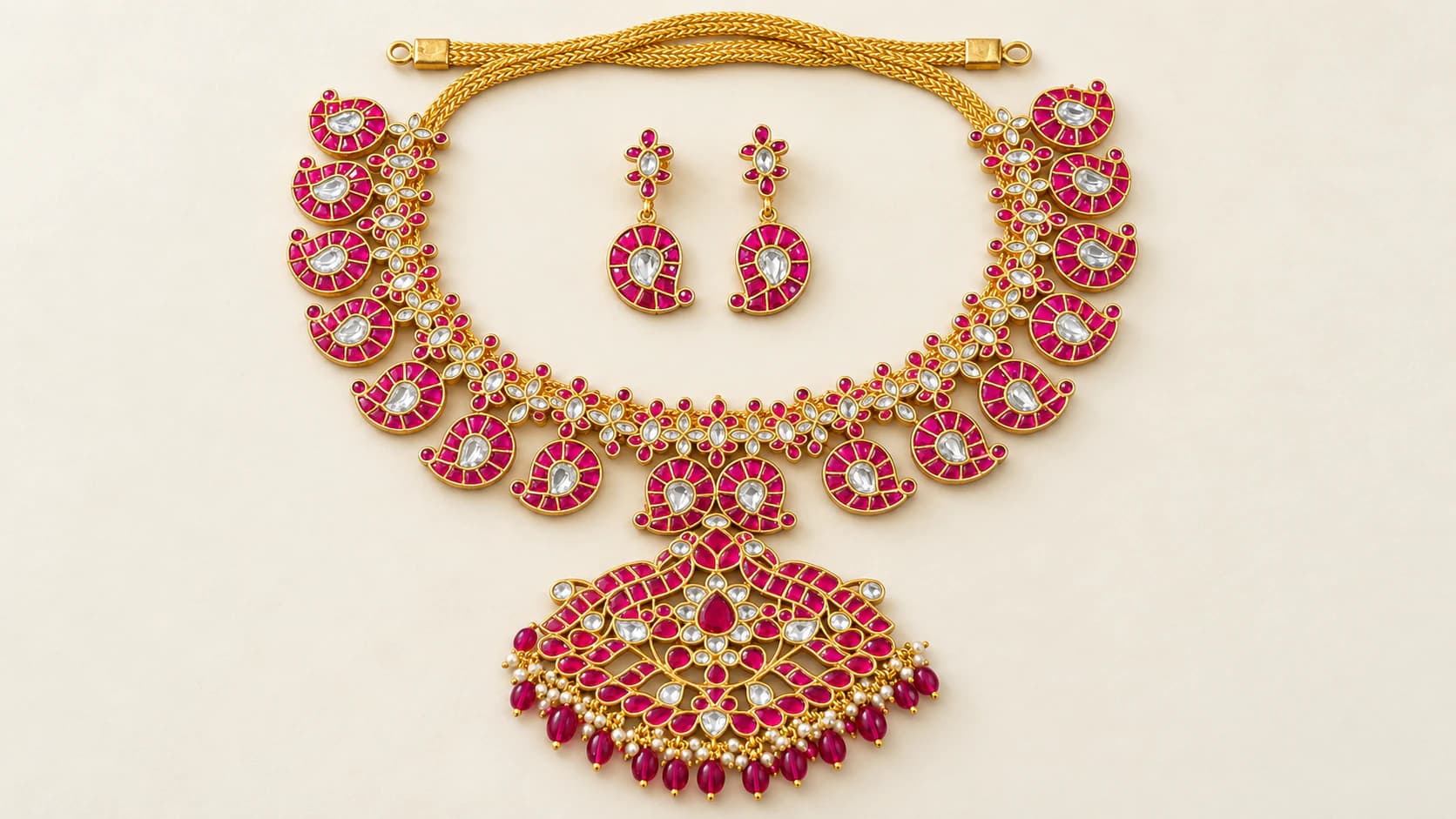
A silver Kundan necklace can look attractive from the front while leaving questions about its backing, stone retention, beading and fastening.
For retailers and wholesalers, assessing silver Kundan jewellery quality means checking the complete piece against an agreed specification. The category name alone does not establish its materials or construction.
This guide focuses on the details buyers should review before approving a sample or confirming a wholesale selection.
Establish What the Supplier Means by Kundan
Traditional Kundan work uses highly refined gold foil worked around gemstones to help secure them. GIA documents this setting tradition in its research on Jaipur jewellery.
Contemporary catalogues also use Kundan as a broader style description. Ask how the selected product is made rather than assuming every item follows the traditional method.
Confirm:
Base metal and stated purity.
Main stones and coloured components.
Setting and backing construction.
Finish.
Beads, drops and other decorative materials.
Our Polki vs Kundan buying guide explains why stone identity and setting terminology should be recorded separately.
Inspect the Stone Surrounds and Seating
Review the stone arrangement under steady lighting, using close-up views where helpful.
Look for stones that appear tilted, unintended gaps, uneven surrounding edges or residue visible around the setting. Compare repeated motifs and corresponding areas on each side.
Ask the manufacturer to explain whether differences arise from the intended design, stone shapes or workmanship that needs correction.
Do not assume every stone should have an identical outline. The comparison should follow the approved layout and sample.
If a stone appears unstable, request professional inspection. Avoid pressing, scraping or attempting to tighten its surround yourself.
Ask About Backing Materials and Their Condition
Backing can affect how a stone looks, but its construction should not be inferred solely from reflections.
Ask whether foil, a closed backing, filling material or another component is used behind the stones. Confirm which details apply to your selected design.
During inspection, note:
Unexpected dark or cloudy areas.
Visible residue or discolouration.
Differences between comparable stones.
Backing that appears displaced or exposed.
Areas where the reverse construction needs explanation.
These observations identify questions for review; they do not independently establish the cause of a problem.
Do not dismantle a setting to inspect hidden materials. Ask the supplier to explain the construction or agree on an appropriate assessment.
Review the Reverse and Contact Surfaces
Turn the piece over and examine areas that touch skin or clothing.
Check setting backs, edges, joints and fastening connections for roughness, sharp projections or visible unfinished areas.
If the reverse has decorative colour or enamelwork, confirm the actual technique and material. A coloured back should not automatically be described as traditional meenakari.
Compare the reverse with the approved specification. Inspect any chips, gaps or uneven coverage and ask whether they require correction.
Photograph the exact location of a concern before cleaning or altering the surface.
Check Beading and Hanging Components Separately
Beading can strongly influence the appearance, movement and fit of Kundan necklace sets.
Confirm the material, colour, size and arrangement of beads and drops. A pearl-like appearance does not establish that a component is a natural or cultured pearl.
Check:
Consistency across corresponding strands or drops.
Spacing and intended length.
Visible fraying or poorly finished thread ends.
Attachment points.
Movement without repeated tangling or trapping.
Use normal handling. Do not pull strands forcefully to test their strength.
Ask how replacement beads, restringing or repairs would be handled if those services are relevant to your order.
In Varnya’s quotation terminology, set Polki and stones are included in quoted net weight, while beading weight is recorded separately. Keep this billing definition distinct from silver-alloy-only weight.
Assess the Necklace and Earrings Together
Review the complete set in the selected finish.
Compare the colour, stone arrangement and decorative components across the necklace and both earrings. Confirm that any intended differences are documented.
For necklaces, check:
Wearable length and adjustment range.
How the central section sits.
Movement between connected motifs.
Pendant and drop orientation.
Closure operation.
For earrings, inspect their dimensions, fastening position and hanging balance. Assess fit where practical and hygienically appropriate.
Confirm which pieces are included in the quotation. Matching earrings shown in an image do not automatically establish the supplied set contents.
Approve the Finish Against a Reference
Gold polish, Victorian polish and silver-coloured finishes are finish choices rather than base-metal specifications.
Compare the set under consistent lighting and review the front, back, links and closures.
Record the intended brightness, colour and placement of darker detailing. Intentional antique effects should be distinguished from unwanted patches.
Our guide to Victorian polish vs gold polish explains how to document finish approval.
Ask for product-specific care instructions. Do not use silver dips, abrasive cloths, steam or ultrasonic cleaning unless the complete piece has been assessed as suitable.
Verify Material Claims Separately from Appearance
A visual workmanship review does not establish silver purity or gemstone identity.
Request written specifications and ask what evidence supports the metal claim. Confirm whether any report applies to the selected article, a sample, raw material or a batch.
Our guide to verifying 925 silver jewellery explains how to review markings and supporting documentation.
Likewise, an attractive setting does not prove that traditional gold foil has been used. Confirm the process if it forms part of your purchase requirement.
Record Findings Before Approving the Order
Inspection areaWhat to recordProduct identitySKU, variant and set contentsMaterialsMetal, stones, backing and decorative componentsSettingsLocation and photographs of visible concernsReverseEdges, joints, finish and decorative workBeadingMaterial, arrangement and attachment detailsFit and functionDimensions, movement and closure operationFinishApproved reference and observed differencesDecisionAccepted details, required changes and next step
Use precise feedback such as “left earring drop differs in colour from the approved sample.”
Before production proceeds, confirm whether the piece is approved, requires revision or has been accepted only for a limited purpose. Our jewellery sample approval checklist provides a broader approval record.
Discuss Wholesale Silver Kundan Jewellery with Varnya Jewels
Varnya Jewels works with retailers, wholesalers and jewellery brands sourcing jewellery from Jaipur.
Share your preferred Kundan designs, silver requirements, finish, quantities and delivery destination. Request the specifications and available product details for your selection.
Request our wholesale silver Kundan catalogue or book a Kundan jewellery video call.
End of story
Thank you for reading.