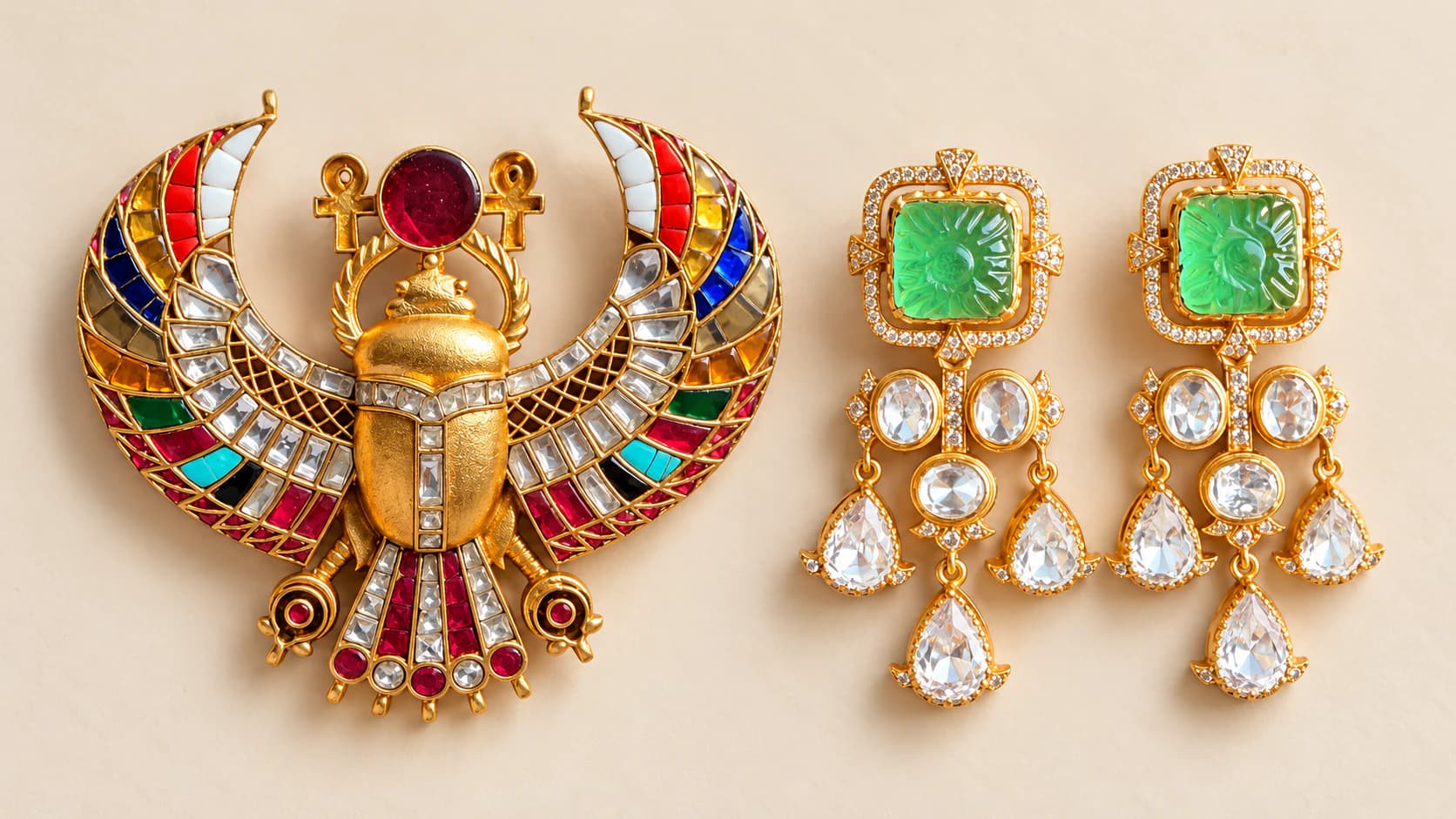
The Story
Polki vs Kundan: What Retailers Should Specify Before Ordering
Retailers researching Polki vs Kundan often encounter a simple explanation: one uses diamonds and the other uses glass.
That distinction is incomplete. Polki traditionally describes diamond cuts, while Kundan refers to a setting tradition involving highly refined gold foil. A piece can therefore contain Polki diamonds set using the Kundan method.
Contemporary wholesale descriptions also use these words for broader styles and product ranges. Before ordering, buyers need to establish the actual stones, metal and construction behind the label.
What Does Polki Mean?
In traditional diamond jewellery, Polki refers to diamonds fashioned in relatively simple, often flat forms that can retain irregular outlines.
These stones may be shaped and polished. Describing every Polki diamond as entirely untouched or unworked is therefore inaccurate.
GIA’s research documents flat Polki diamonds used in traditional Indian jewellery and explains how they can be set using gold foil.
In contemporary catalogues, descriptions such as “Moissanite Polki” indicate a different gemstone material used for a Polki-inspired appearance. They should not be interpreted as natural diamond specifications.
Ask what “Polki” means for each selected SKU.
What Does Kundan Mean?
Traditional Kundan work involves thin, highly refined gold foil worked around gemstones to help secure them.
GIA describes this method in its research on Jaipur jewellery. It also documents the use of Polki diamonds within Kundan settings, demonstrating that the terms can overlap. Read GIA’s Jaipur jewellery research.
Kundan does not, by itself, identify every stone in a piece. Nor should a contemporary trade label be treated as proof of a particular gold purity or manufacturing process.
If traditional gold-foil setting is part of your requirement, state that explicitly and ask the supplier to confirm the construction.
Polki vs Kundan: Compare the Right Characteristics
QuestionPolki descriptionKundan descriptionTraditional meaningRefers to diamond fashioning or cutsRefers to a gold-foil setting traditionCan the terms overlap?Polki diamonds can be Kundan-setKundan settings can hold Polki diamondsDoes the name establish the base metal?NoA contemporary label alone does notDoes it identify every stone?NoNoWhat should buyers request?Stone identity, cut and product specificationStone identity, setting method and product specification
For wholesale buying, the useful comparison is between fully specified products rather than names alone.
Clarify the Main Stones and Accent Materials
Request the identity of the main stones separately from smaller accents and coloured components.
Confirm whether the design contains:
Natural diamonds.
Laboratory-grown diamonds.
Moissanite.
Cubic zirconia.
Glass or another identified material.
Additional gemstones, composites or decorative components.
Do not assume that clear stones share one identity throughout the piece. Likewise, a green centre component should not automatically be described as emerald.
Our guide to Moissanite Polki vs diamond Polki explains the gemstone distinction in more detail.
Specify the Metal Independently
A style description does not replace a base-metal specification.
For silver Polki jewellery or silver Kundan jewellery, request the stated silver purity and details of any components made from other metals.
For gold products, confirm the specified gold purity separately from any foil or surface treatment.
Gold polish describes a finish. It does not make a silver-based product solid gold.
Ask what evidence supports the material claim. Our guide to verifying 925 silver jewellery explains the difference between descriptions, markings and supporting evidence.
Ask How the Stones Are Set
Similar-looking pieces can use different construction methods.
Request front, side and back views. Ask the supplier to explain how the stones are secured and whether backing, foil or other materials are used.
If a traditional technique is important to your collection, include it in the purchase specification. If your priority is a particular appearance, state that and ask which construction the manufacturer proposes.
Avoid judging the setting method solely from a front photograph.
For necklace sets, also inspect the connections between motifs, pendant movement, closures and matching earrings. Our Moissanite necklace quality checklist provides relevant construction checks for that product type.
Compare Finish and Beading Separately
Victorian polish, gold polish and silver-coloured finishes should be recorded as finish choices.
They do not establish the stone material or setting technique.
Also specify the identity, colour and arrangement of beads or hanging drops. These components can substantially change the overall appearance and movement of a necklace.
In Varnya’s quotation terminology, set Polki and stones are included in quoted net weight, while beading weight is recorded separately. This quoted net weight is not the silver-alloy-only weight.
Ask how the selected product’s weight and charges will be recorded before comparing quotations.
Avoid Fixed Price Assumptions
There is no reliable universal rule that every product labelled Polki costs more than every product labelled Kundan.
Prices depend on the actual specifications, including:
Stone materials, sizes and quantities.
Metal purity and weight basis.
Setting and construction.
Finish requirements.
Beading and additional components.
Set contents.
Order quantity and development work.
A natural diamond piece and a silver-based Moissanite design are different products, even if their silhouettes resemble each other.
Compare equivalent specifications and complete costs. Our guide to comparing wholesale silver jewellery quotations explains how to organise that review.
Request a Product Specification Before Ordering
Use this checklist for each selected design.
ItemWhat to confirmProduct referenceSKU and approved design versionStonesMain stones, accents and coloured componentsMetalBase metal, purity and mixed componentsSettingConstruction method and backing where applicableFinishApproved tone and treatmentBeadingMaterials, colour, arrangement and separate chargesSet contentsNecklace, earrings and other included piecesWeightDefined quotation and billing basisEvidenceAvailable documentation or testingOrder termsQuantity, samples, price and delivery arrangements
If a description remains ambiguous, ask for clarification before approving the purchase.
Use Clear Retail Product Names
Keep familiar category language while identifying the materials accurately.
Where supported by the specifications, a product name might be:
“925 Silver Moissanite Polki Necklace Set with Victorian Finish.”
Another product might be described as:
“925 Silver Kundan-Style Necklace Set with Gold-Polish Finish.”
These are naming examples, not specifications for every Varnya product. Use “Kundan-style” where it accurately describes the appearance and avoids implying an unverified traditional setting method.
For diamond products, identify whether the diamonds are natural or laboratory-grown. Avoid using “diamond” merely to describe sparkle.
Discuss Your Polki and Kundan Requirements with Varnya Jewels
Varnya Jewels works with retailers, wholesalers and jewellery brands sourcing jewellery from Jaipur.
Share your design references, required stone materials, base metal, finish and approximate quantities. Confirm the specifications for the selected products before ordering.
Request our wholesale Polki and Kundan catalogue or book a video call to review the collection.
End of story
Thank you for reading.