The Story
How to Verify 925 Silver Jewellery Before a Wholesale Order
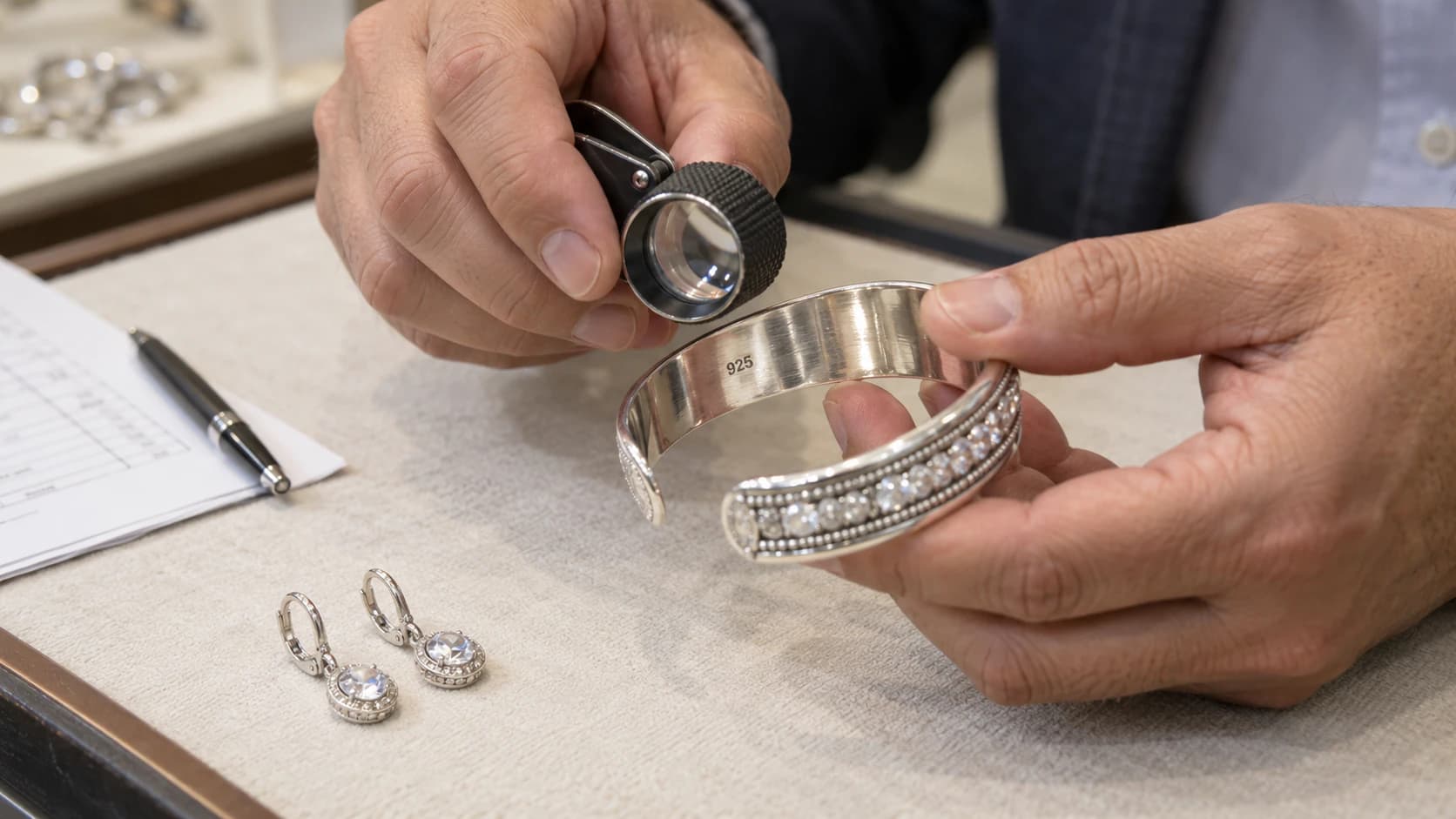
A product description says “925 silver,” and the sample carries a 925 stamp. What should a wholesale buyer check next?
For retailers, wholesalers and jewellery brands, the material claim should be supported by clear specifications and appropriate evidence. Appearance, weight and a photograph of a marking cannot answer every question about the metal.
Understanding how to verify 925 silver jewellery starts with separating the stated purity, the product marking and the evidence supporting that claim.
Understand What 925 Refers To
The designation 925 expresses a silver fineness of 925 parts per thousand, equivalent to 92.5% silver in the stated alloy.
It does not mean that 92.5% of a complete stone-set necklace’s gross weight is pure silver. Stones, beads and other components need to be distinguished from the metal.
It also does not identify the gemstones, coating or finishing process.
Request a specification that records the base metal and stated purity separately from the stones, finish and weight information.
Get the Material Description in Writing
Before discussing verification, establish exactly what the supplier is claiming.
Ask for:
Product reference or SKU.
Base metal and stated purity.
Details of any components made from other metals.
Main stones and decorative materials.
Finish or plating description.
Available markings and testing evidence.
For a necklace set, confirm whether the description applies to the necklace and earrings together.
When reviewing 925 silver Moissanite jewellery, request details for the selected SKUs. A collection description should not replace the specification for an individual item.
Distinguish a 925 Stamp from a Hallmark
A 925 stamp communicates a fineness claim. By itself, it does not establish who tested the article or whether it passed an independent hallmarking process.
If a supplier describes an item as BIS-hallmarked, ask to see the applicable hallmark and supporting identification.
India’s official announcement introduced HUID-based silver hallmarking under IS 2112:2025 from 1 September 2025. It describes the hallmark components as the BIS Standard Mark with “SILVER,” the purity grade and a Hallmarking Unique Identification code.
Do not treat the number 925 alone as equivalent to that complete hallmark.
Verify Hallmark Details Where Applicable
For an item carrying the HUID-based silver hallmark, use the BIS Care app to check the identification details.
The official announcement explains that buyers can retrieve information including fineness, hallmarking date, the assaying and hallmarking centre, and the jeweller’s registration details. Read the official silver hallmarking announcement.
Compare the retrieved information with the article and the supplier’s documents.
If older stock carries a different marking format, request clarification and check the applicable BIS guidance rather than assuming it follows the newer format.
Hallmarking requirements can change. Confirm the current rules for the transaction and destination instead of applying gold-jewellery requirements automatically to silver.
Ask What the Testing Evidence Covers
“Tested silver” is incomplete without identifying the test and the item tested.
Ask:
Who performed the test?
Which method was used?
What item or sample was examined?
When was it tested?
Does the report identify the SKU, sample or batch?
What conclusions and limitations are stated?
A report for raw material does not, by itself, establish that every finished component has the same composition.
Likewise, a result for one selected sample is evidence about that sample within the test’s scope. It should not be presented as testing of every piece in a shipment.
Agree how the evidence will relate to your actual order.
Understand the Scope of XRF Testing
X-ray fluorescence, or XRF, is used to analyse elemental composition, including precious-metal content. Its usefulness depends on suitable equipment, calibration, the article and interpretation of the result.
For coated or mixed-construction jewellery, tell the testing provider about the finish and ask whether the proposed method can answer your question about the underlying metal.
Avoid treating one instrument reading as a complete assessment of an intricate piece with multiple components. Ask the testing provider to explain which areas were examined and any limitations.
If further analysis is required, agree on the method, cost and whether the article could be altered before proceeding.
Keep Purity Verification Separate from Weight Calculations
A weight figure measures mass. It does not establish silver purity.
Also check how the supplier defines quotation terms such as “net weight.” These descriptions may refer to a billing basis rather than metal-only weight.
In Varnya’s quotation terminology, set Polki and stones are included in the quoted net weight, while beading weight is recorded separately. That quoted net figure must therefore not be treated as the silver-alloy-only weight.
Do not multiply it by 0.925 to calculate pure silver content. That calculation would require the actual relevant silver-alloy weight and a justified purity assumption.
Ask for weight definitions and purity evidence separately.
Agree a Verification Plan Before Ordering
For a new supplier or a substantial purchase, discuss the evidence required before confirming the order.
Record:
RequirementWhat to agreeMaterial specificationMetal, purity, mixed components and finishProduct identificationSKU, sample reference or batch detailsHallmark claimApplicable markings and verification detailsTestingProvider, method and scopeTimingBefore production, before dispatch or on receiptCostsResponsibility for agreed testing chargesDifferencesHow conflicting results will be reviewed
Keep this plan practical and specific to the order.
Purity verification is one part of sourcing. Use our jewellery sample approval checklist to review dimensions, construction, finish and wearability separately.
Retain Records for Repeat Orders
Keep the quotation, invoice, material specification and relevant verification documents together.
Record any approved changes to fittings, stones, coatings or construction. For repeat orders, ask whether the earlier evidence remains relevant or whether updated documentation is needed.
Supplier registration documents, a purity report and a finished-product invoice serve different purposes. Check each claim against the document intended to support it.
Discuss Your Silver Jewellery Requirements with Varnya Jewels
Varnya Jewels works with jewellery retailers, wholesalers and brands sourcing silver jewellery from Jaipur.
Share your selected designs, quantities, finish preferences and required documentation. Confirm the available specifications and verification arrangements for your order before purchase.
Request product specifications and wholesale pricing to discuss your requirements.
End of story
Thank you for reading.