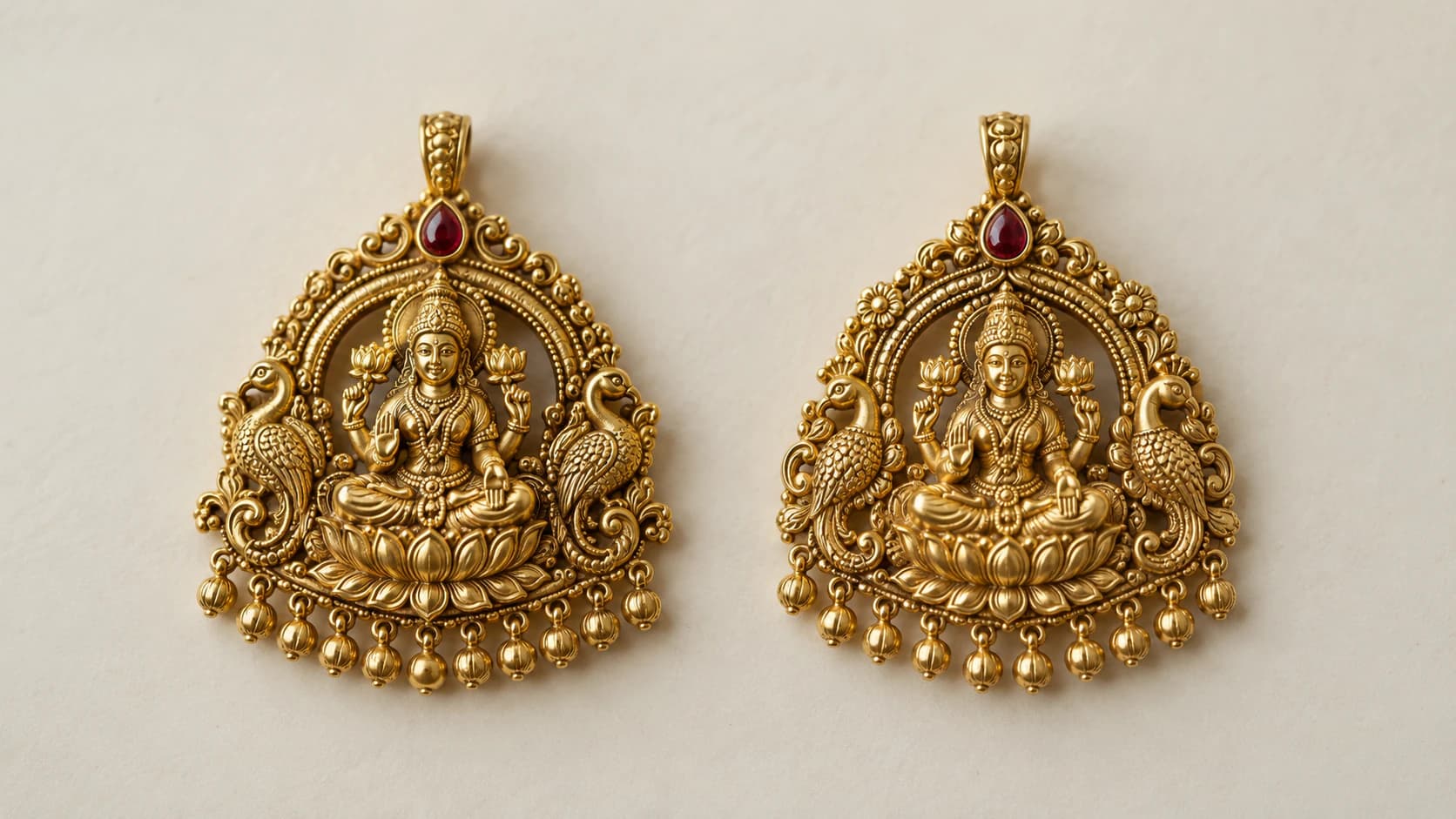
The Story
Silver Temple Jewellery vs Imitation Temple Jewellery: A Wholesale Buyer’s Guide
Two Temple necklaces can share similar motifs and a warm gold-coloured finish while being made from different metals.
For retailers comparing silver Temple jewellery vs imitation Temple jewellery, the first question is what lies beneath the surface. The base metal affects the product description and cost, while construction and workmanship determine how the piece performs as jewellery.
This guide explains what to compare before selecting a wholesale range.
Temple Describes the Design, Not the Metal
Temple jewellery is a design category. The name alone does not establish whether a piece is made from silver, gold, brass or another material.
Likewise, a gold-coloured surface does not establish a solid-gold product.
Request a written specification for the selected SKU rather than relying on a category name or photograph. Record the base metal, stated purity, finish, stones and other decorative components separately.
What Is Silver Temple Jewellery?
Silver Temple jewellery uses silver as the specified underlying metal, subject to the actual construction and components.
Where a piece is described as 925 sterling silver, the designation refers to an alloy containing 92.5% silver. It does not mean that 92.5% of a complete stone-set necklace’s gross weight is pure silver. The FTC’s material guide explains the 925 designation.
Confirm whether clasps, posts, connecting components and other fittings follow the same specification or contain different materials.
A silver base may carry a gold-polish or antique-style finish. The finished appearance and the underlying metal should both be stated accurately.
What Does Imitation Temple Jewellery Mean?
“Imitation” is a broad commercial description rather than a precise metal specification.
Ask the supplier to identify the actual base metal. Descriptions such as brass, copper alloy or another named alloy provide more useful information than “imitation” alone.
Do not assume that all imitation pieces share the same construction, coating or quality.
A well-made base-metal piece can suit a particular collection brief. Its materials should still be disclosed clearly so retailers can describe it accurately.
Compare the Products Side by Side
ConsiderationSilver Temple jewelleryImitation Temple jewelleryBase metalSilver alloy, with purity specifiedActual metal or alloy must be identifiedSurface appearanceMay have gold, antique or other finishesMay have similar-looking finishesMaterial evidenceRequest evidence supporting silver claimsRequest a clear composition and finish descriptionWorkmanshipRequires inspectionRequires inspectionPricingDepends on metal, construction and other inputsDepends on metal, construction and other inputsRetail descriptionState silver purity and finish accuratelyState the identified base metal and finish accurately
Neither a photograph nor the category label establishes all these details.
Do Not Use Colour or Weight as Proof
Similar surface treatments can make different base metals look alike.
A heavier piece is not automatically silver, and a lighter piece is not automatically imitation. Dimensions, hollow or solid construction, stones and decorative components all affect the total weight.
Visual inspection also cannot verify silver purity.
For material evidence, use our guide to verifying 925 silver jewellery. Keep purity verification separate from checking the finish or weighing the complete piece.
Assess Motif Detail and Construction
Compare samples for workmanship regardless of the base metal.
Inspect:
Definition of the intended motifs.
Unwanted roughness or sharp edges.
Reverse surfaces.
Links between decorative sections.
Pendant orientation.
Closure operation.
Matching earring construction.
Review whether polishing has softened details that were important to the approved design.
A silver specification does not excuse poor construction. Equally, a base-metal product should be assessed against its agreed workmanship standard rather than dismissed solely because it is not silver.
Specify the Finish and Care Requirements
Ask what treatment creates the gold-coloured, antique or darkened appearance.
Confirm the intended tone, coverage and any available coating specifications. Review the front, back, links and fastenings against an approved reference.
Our guide to Victorian polish vs gold polish explains how to document finish choices.
Do not infer coating life from the base metal alone. Ask for product-specific care instructions and the scope of any durability claim.
Avoid promising permanent colour, waterproof performance or a fixed lifespan without supporting evidence for the supplied product.
Compare the Complete Wholesale Cost
There is no universal price ratio between silver and imitation Temple jewellery.
Compare products with clearly identified differences in:
Base metal and weight.
Motif size and construction.
Stones and decorative materials.
Setting and assembly work.
Finish.
Set contents.
Packaging and order quantities.
Ask which weight attracts each charge and whether stones, beading and other components are included.
For relevant Varnya stone-set products, the quoted net weight includes set Polki and stones, while beading is recorded separately. Confirm the calculation for the selected Temple design rather than applying one weight assumption to every product.
Use our guide to comparing wholesale silver jewellery quotations when reviewing supplier offers.
Choose According to Your Retail Requirement
Start with what your customers are seeking.
A business serving buyers who specifically request silver needs a range supported by clear silver specifications. A store developing a fashion-jewellery range may have a different material and price brief.
Consider:
Customer enquiries about metal.
Intended purchase and selling-price ranges.
Preferred sizes and visual weight.
Expected wearing occasions.
Stock budget.
Sales-team knowledge.
Reorder requirements.
You can offer different material ranges, provided they are clearly distinguished in product names, catalogues and sales conversations.
Approve a Representative Sample
Choose a sample that reflects the design complexity and finish you intend to order.
Check dimensions, fit, movement, contact surfaces and matching pieces. Confirm material evidence separately.
If you plan to buy several distinct constructions, inspecting one simple pendant may leave important questions unanswered.
Use our jewellery sample approval checklist to record accepted details and required changes before production.
Use Clear Product Names
Where supported by the specifications, a silver product could be described as:
“925 Silver Temple Necklace Set with Gold-Polish Finish.”
A brass product could be described as:
“Brass Temple Necklace Set with Gold-Coloured Finish.”
These are naming examples, not specifications for every Varnya product.
Avoid using “silver” merely to describe colour when the wording could imply a silver base. Likewise, gold polish should not be presented as solid gold.
Discuss Wholesale Temple Jewellery with Varnya Jewels
Varnya Jewels works with retailers, wholesalers and jewellery brands sourcing jewellery from Jaipur.
Share your preferred Temple designs, required silver purity, finish, quantities and delivery destination. Confirm available specifications and order terms for your selection.
Request our wholesale silver Temple jewellery catalogue or book a Temple jewellery video call.
End of story
Thank you for reading.