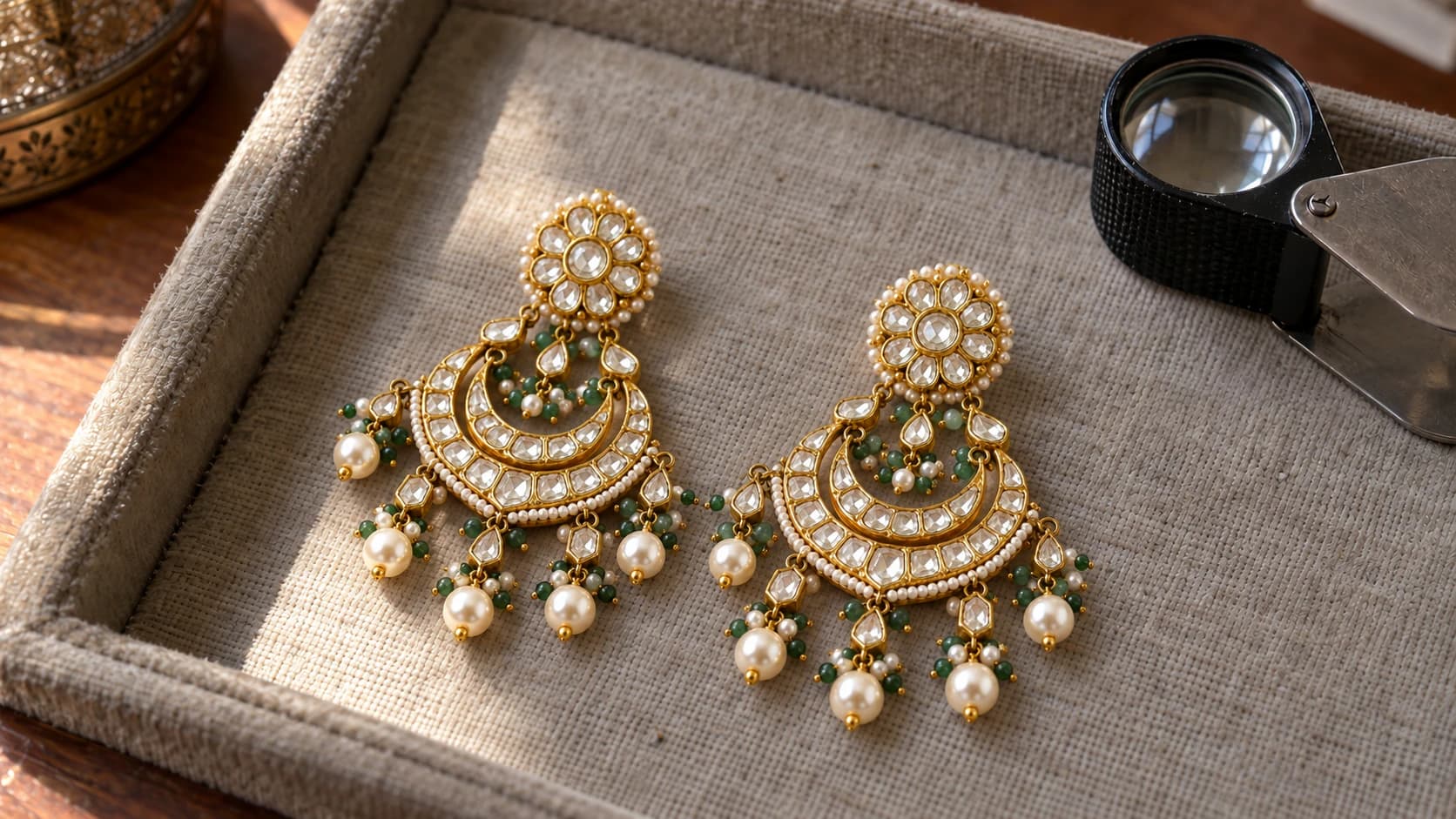
The Story
Moissanite Polki vs Diamond Polki: A Retailer’s Guide
Moissanite Polki and diamond Polki jewellery can share similar silhouettes, stone arrangements and traditional styling. However, they contain different gemstone materials, and that difference matters when sourcing stock and describing it to customers.
For jewellery retailers, wholesalers and brands, comparing Moissanite Polki vs diamond Polki starts with stone identity. The metal, construction, finish and supplied documentation should then be assessed separately.
This guide explains the distinctions and the specifications to request before placing a wholesale order.
What Is Diamond Polki?
Diamond Polki refers to jewellery using diamonds fashioned in traditional Polki cuts. These stones can retain irregular outlines and have relatively simple polished surfaces.
Calling them completely “uncut” can be misleading. GIA describes Polki as a family of traditional Indian diamond cuts that can involve shaping, polishing and light faceting. Read GIA’s explanation of Polki diamonds.
When buying diamond Polki, request written confirmation of whether the diamonds are natural or laboratory-grown. The term “Polki” alone does not provide a complete material specification.
Also confirm the metal purity, diamond weight, any treatments or backing, and what testing or documentation applies to the supplied jewellery.
What Is Moissanite Polki?
“Moissanite Polki” is a trade description used for jewellery featuring Moissanite fashioned or arranged to create a Polki-inspired appearance. Ask the supplier what that description means for each selected design.
Moissanite is silicon carbide. It is a different gemstone material from diamond and should not be described as natural diamond or laboratory-grown diamond. GIA distinguishes Moissanite from both types of diamond. See GIA’s guide to Moissanite and laboratory-grown diamonds.
A product described as Moissanite Polki may also contain coloured stones, beads, pearls or other decorative components. Request their identities separately rather than assuming every stone in the design is Moissanite.
Moissanite Polki vs Diamond Polki: Key Differences
ComparisonMoissanite PolkiDiamond PolkiMain stoneMoissanite, a silicon carbide gemstoneDiamondMeaning of “Polki”Usually describes the intended style or stone fashioning in trade usageRefers to traditional diamond cutsDiamond originMoissanite is not diamondConfirm natural or laboratory-grown originBase metalMust be specified separatelyMust be specified separatelyAppearanceDepends on cut, proportions, settings and backingDepends on cut, proportions, settings and backingPricingDepends on stones, metal, construction and workmanshipDepends on diamond specifications, metal, construction and workmanshipProduct descriptionClearly identify MoissaniteClearly identify diamond and its origin
The collection name should help buyers browse. The written specification should establish what they are purchasing.
Does Moissanite Polki Always Mean Silver Jewellery?
No. The stone name does not establish the base metal.
Moissanite jewellery can be made in different metals, just as diamond jewellery can. Confirm the actual material and purity for the selected SKU.
For silver jewellery, request:
Stated silver purity.
Gross jewellery weight.
Net silver weight and its calculation basis.
Available purity-testing evidence.
Details of components made from other materials, if any.
Gold polish and Victorian polish describe finish choices. Gold-polished silver remains silver jewellery with a finish; it should not be presented as solid gold.
When exploring 925 silver Moissanite jewellery, review the specifications of individual designs alongside the collection description.
Can You Tell the Difference from Photographs?
Photographs help buyers assess design, proportions and visible finishing. They do not reliably establish gemstone identity.
Lighting, editing, backing and camera exposure can change how clear stones appear. A bright reflection or softer glow is not sufficient evidence that a stone is Moissanite or diamond.
Do not rely on a basic thermal tester alone either. Some thermal probes can react to Moissanite as though it were diamond because of its thermal properties. Appropriate identification methods are necessary.
For wholesale sourcing, request written stone specifications and clarify what identification evidence is available. Where independent verification is important to the order, agree on its scope before payment.
How Should Retailers Compare Prices?
Compare complete specifications rather than applying a fixed price relationship between Moissanite Polki and diamond Polki.
Two similar-looking necklaces may differ in:
Stone identity, size and quality.
Natural or laboratory-grown diamond origin, where applicable.
Metal type, purity and weight.
Number of components and setting complexity.
Finishing and decorative materials.
Set contents.
Testing, packaging and order requirements.
Request itemised quotations or clear all-inclusive prices with the same scope.
Avoid assuming that a lower-priced piece is poor quality or that a higher-priced piece has better workmanship. Material value and manufacturing quality are separate considerations.
Which Collection Fits Your Retail Business?
Choose according to the customer requirement you intend to serve.
A Moissanite Polki range may fit a collection brief seeking Polki-inspired styling with Moissanite as the stated gemstone. Diamond Polki fits a brief that specifically requires diamond.
Before selecting an assortment, ask:
Are customers requesting diamond specifically, or a particular appearance?
What materials can your sales team explain confidently?
What purchase budget and stock commitment suit the business?
Can the supplier reproduce the agreed specifications?
What after-sales arrangements can you accurately offer?
If you stock both, distinguish them clearly in catalogues, quotations, invoices and sales conversations. Similar styling does not make them interchangeable products.
What Should You Request from a Wholesale Supplier?
Use a written specification for every selected design.
ItemWhat to confirmMain stonesMoissanite, natural diamond, laboratory-grown diamond or another identified materialAdditional componentsIdentity of coloured stones, pearls, beads and accentsMetalBase metal and stated purityWeightGross weight, net metal weight and stone weight where applicableConstructionSettings, backing, joints, closures and set contentsFinishApproved colour, treatment and sample referenceEvidenceWhat testing or documentation covers the supplied itemsOrder termsMOQ, payment, sampling, production and defect arrangements
For the wider sourcing process, read our wholesale Moissanite Polki buying checklist.
Describe the Jewellery Clearly to Customers
Product names should state the material before relying on style language.
Where supported by the actual specifications, a clear description might be:
“925 Silver Moissanite Polki Necklace Set with Gold-Polish Finish.”
For a verified natural diamond product, an appropriate description might identify:
“Natural Diamond Polki Necklace Set in 18K Gold.”
These are examples of naming formats, not specifications for every Varnya product.
Avoid using “Moissanite diamond” as though the two materials are the same. Likewise, do not describe a coloured stone as emerald or a pearl-like component as a cultured pearl without confirmation.
Accurate descriptions help your team answer questions consistently and give buyers a clear basis for their purchase.
Explore Moissanite Jewellery with Varnya Jewels
Varnya Jewels works with retailers, wholesalers and jewellery brands sourcing 925 silver jewellery from Jaipur.
Share your preferred designs, quantities, finish and delivery destination to discuss a suitable selection. Ask for the material specifications and available product details for each chosen design.
Request the wholesale Moissanite catalogue or arrange a video call to review the collection.
End of story
Thank you for reading.